Arcadia
Creative Lead, UX
Challenge
Arcadia was founded on the idea that virtual reality can become full-scale athletic endeavour where players run, jump, sweat, and compete in next generation digital sports. While achieving impressive large-scale multiplayer results, the project faced a critical challenge: it was unable to scale past a controlled demo phase to reach a global audience.
In my role as Creative Lead, I pitched and led the creative direction of a digital sports ecosystem designed to bridge the gap between high-end location-based entertainment and accessible at-home play. Inspired by the idea of a back yard basketball hoop, my goal was to create a seamless journey for the Arcadia athlete: giving them a way to train and master their skills at home before competing at centralized in-person locations.
Mechanic
01
Ball
02
UX / UI
03
Production
04
01 - The Mechanic
Whether it is a bouncing basketball, or a puck on ice, almost every sport is built around the skill you develop though the game's core mechanic. We set out to build something that is rewarding and fun to improve at, inside or outside of a competitive structure.
As the central point of contact between the physical and digital worlds, we chose hand tracking as the foundation for the core mechanic. We believed that the best controller is the one you are born with.
Arcadia was not built to simulate existing sports in VR - it was built to create new sports that can not exist in reality. This meant pushing beyond the limits of traditional sports in search of something unique to the company's mission.
We had a few basic requirements:
Must be fun to play in a 100 ft VR arena and in your 10 ft living room.
Must have a high skill ceiling in order to inspire dedicated players to improve.
Must be grounded in sports but unique to mixed reality. It must be a mechanic that cannot exist in the real world.
Early concept diagram


Early concept renderings
Energy field demonstration
We anchored the mechanic in a childlike, universal instinct: the desire to summon an object from across a room and the desire to thrust your hand outward to affect your environment.
In short, we gave your hands magic powers.
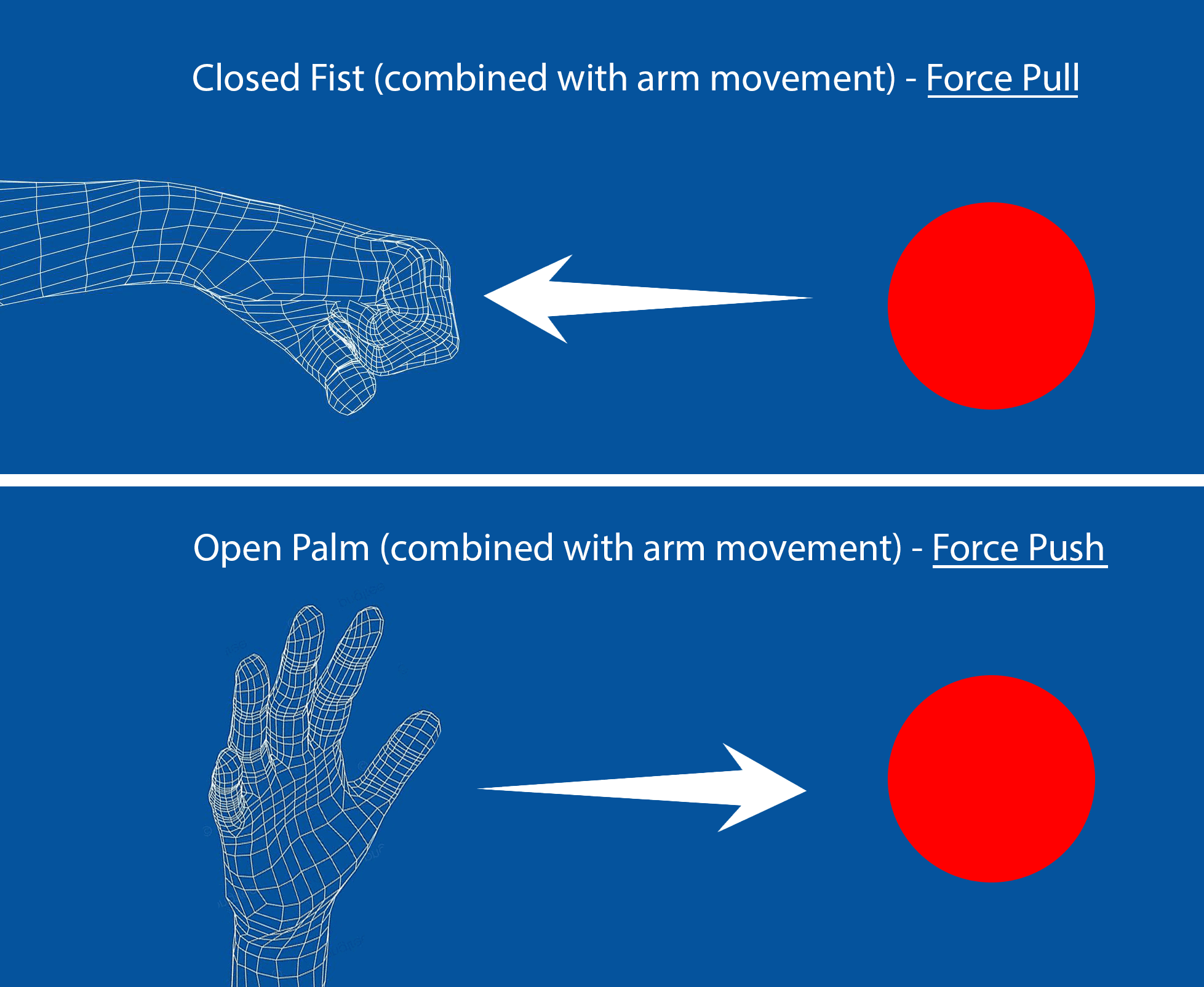
This became a binary system of kinetic control:
• Force Pull - Closed Fist: Energy flows toward the fist.
• Force Push - Open Palm: Energy flows away from the palm.
From this simple structure, we layered nuance through arm velocity, aim, timing, and accuracy - all of which could be used to influence control over the ball.
Inspired by the surface tension in water polo, we introduced a waist-high dynamic energy field to serve as a neutral resting plane. Originally a solution for ball visibility, energy feild became a core feature for creative gameplay.
The clip below shows an early-stage WIP test of the mechanic in a large-scale multiplayer environment. We developed a real-time testing panel that allowed us to tweak variables such as velocity and friction while still in the headset. By comparing settings after each session, we were able to systematically refine the default physics until the interaction felt intuitive for every user, regardless of the physical space they were in.
WIP Large scale multiplayer testing session
After countless hours of testing, iteration, and technical redesign, we reached the flow state we were seeking. The clip below shows an experienced player manipulating the Arcadia ball with the level of skill, creativity, and intuition we set out to enable.
Gameplay skills demonstration
This screen size is not supported at this time, please view on a bigger screen!
This screen size is not supported at this time, please view on a bigger screen!